If 2020 has taught us anything, it's that our lives can change in matter of days...hours. In January, who thought we would go through what has happened in the past six months?
For ten years as we built and lived with our pantry, we called it "preparing for the zombie apocalypse." And we laughed. But I never wondered if we were over-reacting to something that might not happen - we had relied on our pantry already in times of financial difficulty, and we knew something would happen again, even if we didn't know what it was.
And as we face the remaining months of 2020, there is no reason to believe that we won't go back to stay-at-home orders in some states, or won't experience supply chain disruptions (again,) or won't face shortages overnight (remember the toilet paper debacle?)
Prudent people store food.
Storing food means that we gather food (and household supplies) when they are plentiful, affordable and available, and save them for times when they aren’t. It’s as simple as that.
And storing food isn't the same as "hoarding" food. Storing food, like I said above, happens when the supplies are
plentiful, affordable, and available. Hoarding food happens when supplies are threatened, scarce, and when panic reigns. Hoarding food takes more than your share of the available supply, while storing food puts you in a position to help others when the community's supplies get low.
Long-term food storage isn’t a project – a “let’s work on this now and then we’re finished” sort of thing. It’s a lifestyle.
When you live with a pantry, you are constantly using and replenishing your stock and planning for the future.
It’s living a Proverbs 31 kind of life.
What food (and other items) do we store?
There's a saying, "Store what you use and use what you store."
When I build or replenish my pantry, I look at what I normally buy at the grocery store. I look at my regular pantry. I look at my favorite recipes. What shows up most often? I start with a list.
And then I think about non-perishable alternatives to the perishables on that list.
Yes, that can be hard when we're talking about milk, eggs, or fresh produce. Even though we use the fresh versions of all three of those items, I also store canned milk, powdered milk, and frozen and canned fruits and vegetables.
My pantry includes dried beans, rice, whole grains (I have a grain mill) and flours. Baking supplies like baking powder, baking soda, yeast, and salt. I keep dried pasta on hand, along with cans of tomato sauce and tomatoes. I also have a supply of canned meats - beef, chicken, and tuna.
I also keep a LOT of unsweetened chocolate powder on hand, because a girl needs her chocolate!
But that's MY pantry. Take some time to plan what you would store in your pantry.
How much do we store?
When I built my first long-term pantry ten years ago, there were six of us in the household. I aimed for a three-month supply and guessed at the quantities we would need. Experience taught me where I had over-estimated and where I had under-estimated.
Now I don't worry as much about how much is on the shelves because I'm constantly using and re-supplying everything. I plan my purchases, buying for the future instead of the present need.
That's a lot of food to buy. What if you're on a strict budget?
We do it by buying a small quantity at a time. I add about 10% - 20% to my monthly grocery budget for long-term purchases, and then I look for sale items in the grocery flyer. I'll buy ten cans of tomato sauce one week and two pounds of spaghetti noodles the next. Whatever is on sale. I save a lot of money by buying most of our groceries at sale prices!
Another way to do it is to choose one item on your list to buy each week. A package of toilet paper, or a box of trash bags. A box of cereal. A bag of flour. Just keep track of what you buy so you don't over-purchase in one area at the expense of another area.
I think of it as investing in our savings account.
One exception was back in 2010 when we were building our first pantry. Both of us felt an urgency we couldn't explain, so we used our income tax refund to buy the food on my list. Within a month after we had our three-month supply on the shelves, my husband lost his job of thirty years. It was six months before he started at his new job, and money was tight, but that "three-month supply" lasted for the entire time. When he started his new job, we were down to the last few cans of tomatoes, but we didn't go hungry. God's providence at work!
Another exception is when we buy beef for our freezer. I save all year to buy our quarter or half steer from a local rancher. I love doing this because I know where our meat was raised and processed. This year's supply is from a friend's ranch in the Badlands and was processed in Wall, South Dakota, the home of the famous Wall Drug.
Where do I store all this food?
Not all of us have a basement with plenty of room. Believe me, I am thankful for our store room every day!
But there are ways to store your items, even in the smallest apartment.
Don't forget to take a few things into consideration though:
1. Choose a place that doesn't experience extreme temperatures. So attics and garages are generally out.
2. Store your items in varmint-proof containers. I use half-gallon and quart size canning jars for many things, and I also purchased some food-safe plastic containers at Sam's Club years ago. An old cooler can keep mice out. Old pickle buckets from restaurants also work well. Sometimes you have to be creative.
3. Store the food in a way that makes it easy to rotate your purchases - always put the oldest items in front.
Here are some ideas for creative storage:
- I used the closet under the stairway for several years in our old house.
- The closet in a little-used room is a good spot.
- Underneath a bed is great for canned goods. Use a flat cardboard box or plastic storage bin to slide them in and out.
- Some people make a "table" out of a stack of containers. Stack them to the right height, place a piece of plywood on top, cover with a table cloth, and you have a lamp table for your living room.
- Think about the back of your cupboards. Sometimes there is enough space in the back to stack a row of canned goods or boxes, leaving the front for items you use often.
- And for readers...think about all that space in the back of your bookshelves! Instead of double-stacking your books, you can line up cans or boxes behind the front row of books.
And consider investing in a freezer. It doesn't have to be a large one. We have one that's about 15 cubic feet, large enough for a 1/2 steer plus other items. Smaller ones are available for apartments and mobile homes, and larger ones for big families. It's worth the investment!
And what do I do with all my stored items?
I store what I use. I make a point of planning my shopping around
the foods I normally keep in storage, and I only purchase the foods I know we'll use. There isn't much point in buying a fifty-pound bag of lentils, because I'm the only one who likes them. Or buying a brand of dish soap I don't like to use just because it was on sale.
And I use what I store. When I plan my weekly menu, I use items from my long-term pantry. If an item is getting low, I make a note to replenish it soon.
I always remember that I am planning for the future instead of reacting to present need. I don't take last minute trips to the store because I forgot to buy an ingredient for a recipe. I don't worry if the next pay check will stretch far enough to buy the groceries we need. I don't rely on convenience foods just because there isn’t anything else in the house to eat.
My pantry gives me the freedom that comes with prudent living, and I am always thankful for that!
So, let's chat. Do you have a pantry? Or are you overwhelmed by the idea of starting one? Are you ready to jump in?
Jan Drexler is an author by day who is addicted to counted cross stitch and sauntering through the Hills with her dear husband and their puppies - goofy corgi Jack and growing-fast border collie Sam. You can find Jan's books and other fun things on her website: www.JanDrexler.com.


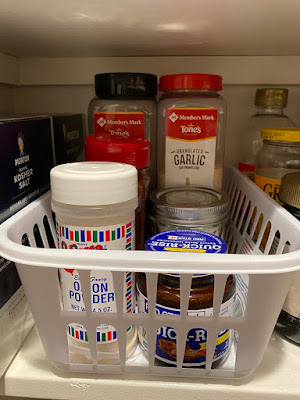
 The biggest job was repackaging a lot of items. Combining multiple packages of the same thing into one central location.
 Those half-gallon size Mason jars are perfect for storage, though I still use some of the Tupperware I bought way back in the 80s.
 It took me all day, but as night fell I once again had an orderly pantry. Save for that wayward box of aluminum foil. Who put that there?
 What could have been a lazy rainy day turned into a productive rainy day. One that had me so jazzed I couldn't wait to move onto the mudroom. Hooray for newfound space!


 Award-winning author Mindy Obenhaus is passionate about touching readers with Biblical truths in an entertaining, and sometimes adventurous, manner. She lives on a ranch in Texas with her husband, two sassy pups, countless cattle, deer and the occasional coyote, mountain lion or snake. When she's not writing, she enjoys spending time with her grandchildren, cooking and watching copious amounts of the Hallmark Channel. Learn more at mindyobenhaus.com


